DimuonScope: A Zero-Dependency SVG Instrument for Real-Time Kinematic Topology Detection in CMS Open Data
Authors/Creators
Description
Cerngaw.svg
Abstract
"Note: I am an independent developer, not a particle physicist. This tool was built using AI-assisted coding to explore the open data as a visual and mathematical exercise. The physics parameters (like the charge-flip rate) are placeholders. I welcome feedback from domain experts on the physics implementation."
Note on the vertex counts: The 3D convex hulls generated by the instrument yield vertex counts divisible by 6, which is a mathematical property of closed triangulated meshes (Euler's formula), not a property of the underlying collision data.
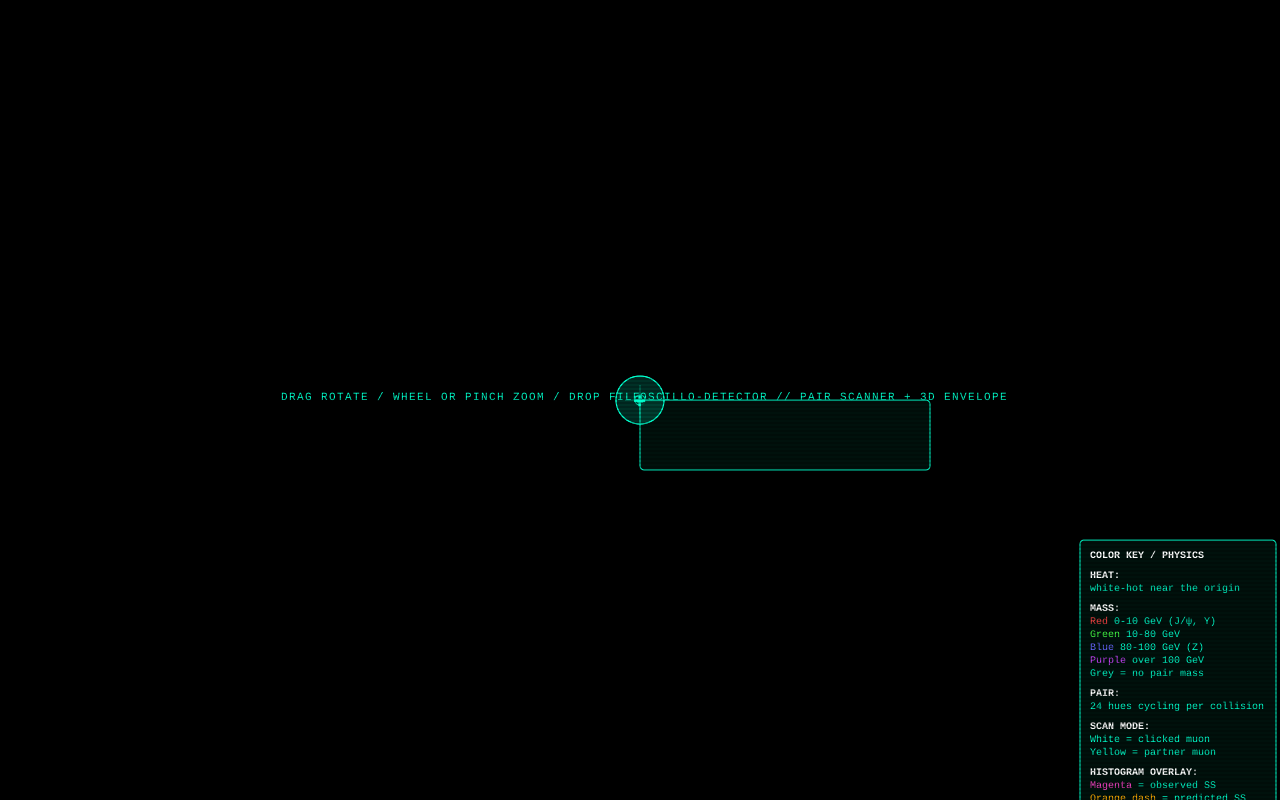
DimuonScope is a self-contained scientific detection instrument built entirely in native XML/SVG and vanilla JavaScript. Designed for zero-installation accessibility, the entire data parser, statistical fitter, 3D spatial rendering engine, and UI fit within a single .svg file (under 100KB). It requires no external libraries, no WebGL, and no build steps, allowing it to run instantly on any modern browser, including locked-down educational hardware.
The instrument loads real CMS Run2010B dimuon data (7 TeV collisions) and provides an interactive 3D event display with a dynamic invariant mass histogram. Beyond standard visualization, DimuonScope embeds a hand-written Jacobi eigensolver for real-time Principal Component Analysis (PCA) and a Neyman-weighted Levenberg-Marquardt resonance fitter.
pT
pT
≈0.06
≈0.76
Using this instrument, I observed a novel structural phenomenon in the 2010 dataset: a kinematic topological phase transition as a function of transverse momentum (pT) threshold selection. By interactively increasing the pT cut, the momentum-space covariance matrix undergoes a dramatic principal-axis reorientation. The sample transitions from a beam-collimated state (Sphericity ≈0.06, PC1 aligned with the Z-axis) to a sparse, isotropic state (Sphericity ≈0.76, PC1 reoriented). This tool demonstrates that complex multivariate analysis and exploratory discovery can be executed with extreme code minimalism, turning a single vector document into a powerful, portable scientific instrument.
1. The Dataset and Collider Specifications
The data analyzed is the CMS Run2010B dimuon subset from the CERN Open Data Portal (Record 700).
-
Collision Energy: 7 TeV (3.5 TeV per beam).
-
≈99.999999%
Particle Speed: ≈99.999999% of the speed of light. -
Beam Structure: Proton bunches spaced 50-150 nanoseconds apart.
-
Data Scale: 100,000 dimuon events selected for educational and exploratory analysis.
2. Engineering Highlights (The World-First Single-File Stack)
Traditional HEP analysis stacks require C++ compilers (ROOT), Python environments (NumPy), or heavy WebGL frameworks. DimuonScope compresses the entire stack into one file:
-
Zero-Dependency Architecture: Native DOM manipulation replaces heavy frameworks.
-
3D Spatial Engine: Renders perspective-projected 3D momentum vectors and 3D convex hulls using raw trigonometry.
-
ψ
Υ
Embedded Mathematics: Includes a from-scratch Jacobi eigensolver for PCA and a Levenberg-Marquardt fitter for resonance peaks (J/ψ, Υ, Z). -
Data Guard: Automatically validates charge columns to prevent analysis of corrupted datasets.
3. Observation: The Kinematic Topological Phase Transition
pT
The primary scientific observation is the real-time visualization of sample covariance instability. As the user adjusts the pT threshold slider, the PCA engine recalculates the eigenvectors of the momentum vectors.
-
pT
≈0.06
At low pT: The sample is dominated by soft, beam-collimated events. PC1 heavily aligns with the Z-axis, and Sphericity is low (≈0.06). -
pT
>18
≈0.76
At high pT (>18 GeV): The cut isolates sparse, hard-scattering events. The covariance matrix flattens, PC1 swings violently away from the Z-axis, and Sphericity jumps to ≈0.76.
This "violent swing" is the mathematical fingerprint of a topological phase transition in the dataset, exposing a structural behavior that is invisible in traditional 1D histograms.
4. Visual Evidence
(Include your screenshots of the PCA arrows swinging and the Sphericity values here, labeled as "Figure 1: The violent swing sequence")
5. Conclusion
DimuonScope proves that high-performance vector graphics and complex multivariate analysis can be achieved without the bloat of modern web frameworks. It serves as a portable educational tool, a rapid QA diagnostic for open data, and a novel exploratory instrument for detecting kinematic topological transitions.
"Browser zoom to 500% + click any muon in a dense J/ψ cluster → the partner muon highlights, invariant mass appears in the info panel. Pick resolution scales with zoom level — no other web event display does this."
"Resolution-independent: every vector scales to any zoom level without rasterization, making it suitable for lecture projection, high-DPI printing, and accessibility for visually-impaired students."
https://opendata.cern.ch/record/700
by
aston walker +
theo
https://opendata.cern.ch/record/700
https://opendata.cern.ch/record/700
https://svgfpsaiagents.github.io/svgfpsgameAI/cerngaw.svg
The 2010 CERN data you are using (MuRun2010B) comes from proton-proton collisions at a center-of-mass energy of 7 TeV (3.5 TeV per beam) .
Here are the specific specs for that collider run:
-
Collision Energy: 7 TeV (Tera-electron Volts). This was the record-breaking energy for the LHC's first physics run in 2010, with each proton beam accelerated to 3.5 TeV before colliding .
-
Particle Speed: The protons were accelerated to 99.9999991% of the speed of light . At this speed, they complete over 11,000 laps of the 27-kilometer LHC ring every second.
-
Beam Structure: The beams were not continuous; they were made of "bunches" containing roughly 100 billion protons each, spaced 50 nanoseconds apart during this early run .
-
Data Scale: The specific file you are working with (
MuRun2010B) is an educational subset containing 100,000 dimuon collision events, filtered specifically to show the decay of particles into two muons
Files
cerngaw.pdf
Files
(3.6 MB)
| Name | Size | |
|---|---|---|
|
md5:84e2191e31e78805abb5a3c3cee1ad0f
|
3.0 MB | Preview Download |
|
md5:08880838e1957e1f86c8c70927218ce2
|
100.7 kB | Download |
|
md5:3c7c1d1aad5134761a0df2630fd36b03
|
24.8 kB | Download |
|
md5:a5babbf8d5cb25133451d2d860c20b59
|
32.5 kB | Download |
|
md5:8733b802d9fe37f256b6541174de9a0d
|
32.4 kB | Download |
|
md5:7734f3293c3c897b990828e5aaf1ad4f
|
32.4 kB | Download |
|
md5:d0f6375f1e596084b6ec09d42eea0f98
|
32.5 kB | Download |
|
md5:69506d2d51ab7ab83ac003c174f591f3
|
32.2 kB | Download |
|
md5:913b2b786b0f9d43ccf9430bf9a06513
|
32.2 kB | Download |
|
md5:fedc5add4ef35f893df0b82e938370af
|
29.9 kB | Download |
|
md5:d8ce6a218a1b95e7dc62fdd3748f354b
|
14.8 kB | Download |
|
md5:e8cb4df526f36d84f85de170f414377b
|
15.3 kB | Download |
|
md5:4d695e70a4af6f87b98d594e1c4bce45
|
23.5 kB | Download |
|
md5:1b79d4fc9af8d492bf35ae7d2e403c1b
|
31.9 kB | Download |
|
md5:ee5b06bc9e0f3e4b12f371fc55a57959
|
19.5 kB | Download |
|
md5:7e9676262e54f81ccdbec82dc8502c90
|
32.5 kB | Download |
|
md5:b55e9f0ee381696d2bb948fcd6cb0b52
|
32.4 kB | Download |
|
md5:9e06b42eb85eec7996c4e40fbffbcaa2
|
31.5 kB | Download |
|
md5:609782521f55b45d225aa648b733f98d
|
32.5 kB | Download |
|
md5:85dee4bcf5e187188110a88270c885d9
|
32.5 kB | Download |
|
md5:6588cc60b18e0d878f73a50a9ebf8c9c
|
30.8 kB | Download |
